What We Learned From Computex 2026 — And How It Connects To Goldman Sachs' Optical Networking Report (CPO Scale Up)
Goldman Sachs sees the destination. Computex 2026 may have shown us the path. How XPU to XPU Optical I/O completes the picture.

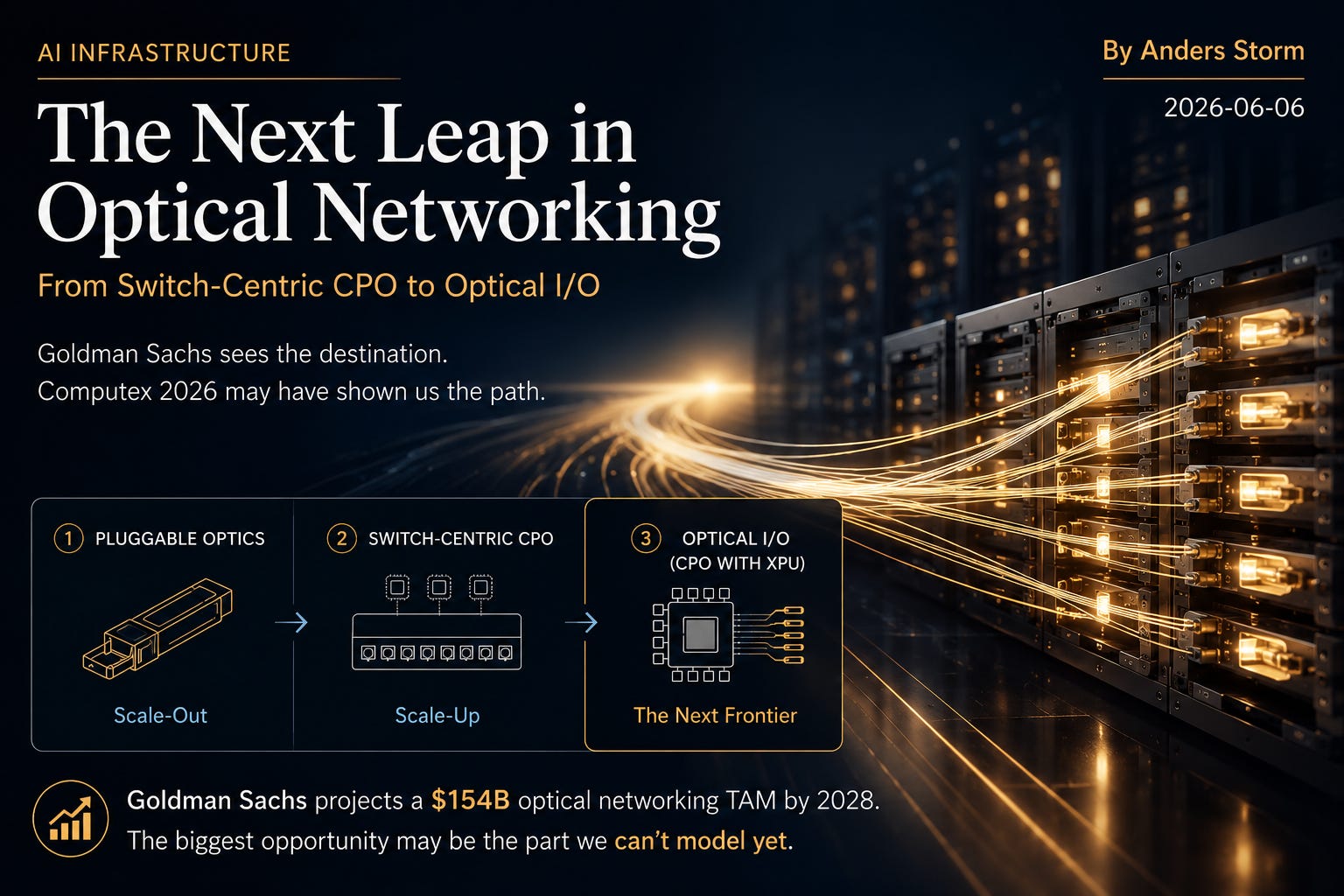
In April 2026, Goldman Sachs published one of the most important reports yet on Optical Networking for AI infrastructure:
Optical Networking: The Next Mega Trend in AI Infrastructure.
The headline numbers immediately grabbed investors’ attention:
Optical networking TAM growing from roughly $15 billion to $154 billion by 2028.
Scale-up networking representing approximately $106 billion of that opportunity.
Co-Packaged Optics (CPO) potentially contributing roughly $91 billion.
Most discussions since then have focused on the size of the market.
But after reviewing the demonstrations presented at Computex 2026, I believe the most interesting takeaway from Goldman’s report may not be the TAM itself.
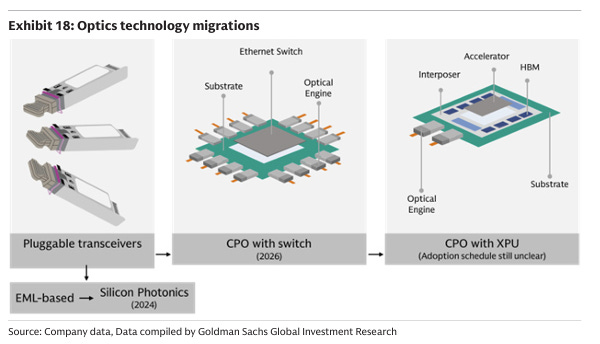
It may be the part of the roadmap Goldman explicitly acknowledges but does not yet know how to model. The below picture shows the pluggable (Scale Out) and CPO (Scale Up) for Switches and that is what the Goldman report is focusing on. However they do not mention any data about CPO for XPU (or as Ayar Labs have called it Optical I/O):
Goldman’s Three-Step Optical Roadmap
The Goldman report effectively describes three stages of AI networking evolution:
Stage 1: Pluggable Optics
This is the world we know today.
800G modules
1.6T modules
EML-based architectures
Silicon photonics gradually entering the market
This is largely an evolution of traditional networking.
Stage 2: Switch-Centric CPO
The next transition is moving optics closer to the switch ASIC.
Examples include:
NVIDIA Spectrum-X Photonics
NVIDIA Quantum-X Photonics
Broadcom CPO platforms
Marvell optical switch architectures
GlobalFoundries SCALE
This is where Goldman spends most of its effort.
The report estimates optical engine counts, external laser source (ELS) counts and rack-level dollar content because the architecture is reasonably well understood.
This is also where the famous $91 billion CPO opportunity originates.
Stage 3: Optical I/O
I find the the final box in Goldman’s roadmap quite interesting especially after Wiwynn Computex announcement of the Rack scale Co-packaged optics for AI scale-up. Placing optics next to the XPU.
Goldman labels this:
CPO with XPU
And then adds a simple note:
“Adoption schedule still unclear.”
That may be the most important sentence in the entire report.
Because Goldman is effectively saying:
We know where the industry is going.
We do not know when it arrives. However, the Wiwynn and Ayar Labs Computex demonstration suggests the industry is progressing beyond theoretical concepts and toward deployable Optical I/O architectures.
Important to note Wiwynn is an ODM (Original Design Manufacturer), it is a company that designs, develops, and manufactures products that are ultimately branded and sold by another company under that buyer's brand name. They almost never publicly announces customers by name because it’s an ODM. That’s the business model. But the industry has a very good idea who the major customers are.
The strongest publicly supported names are:
Meta Platforms
Microsoft
Amazon Web Services
Multiple sources describe Wiwynn as a major supplier to hyperscale cloud providers, especially Meta and Microsoft.
What Computex 2026 Revealed
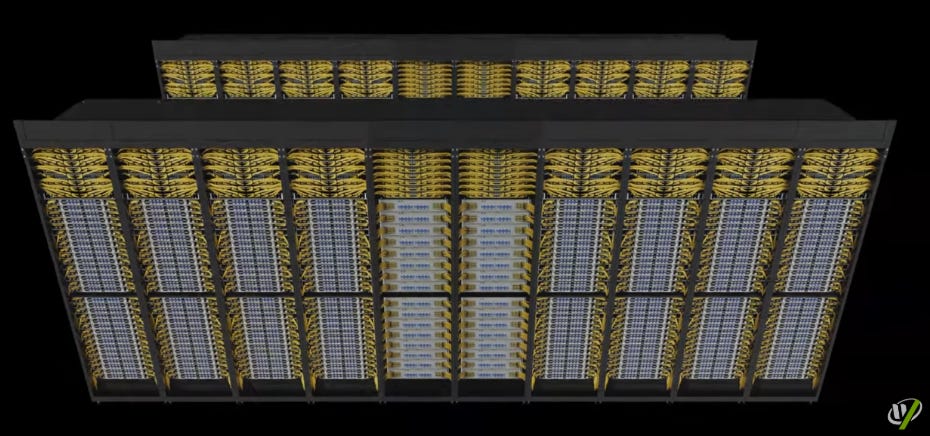
At Computex 2026, Wiwynn and Ayar Labs (and many other partners) demonstrated something that appears remarkably close to Goldman’s third box.
The joint full rack solution featured:
32 AI compute trays
64 AI ASICs
More than 800 TB/s optical bandwidth
TeraPHY optical engines
Publicly presented system diagrams indicate up to 16 SuperNova light source assemblies per compute tray. Applied across 32 trays, this implies a theoretical maximum of 512 SuperNova assemblies within the compute rack architecture.
Rack-scale optical connectivity designed for hyperscale AI infrastructure.
A link to the full video about the solution you can find here.
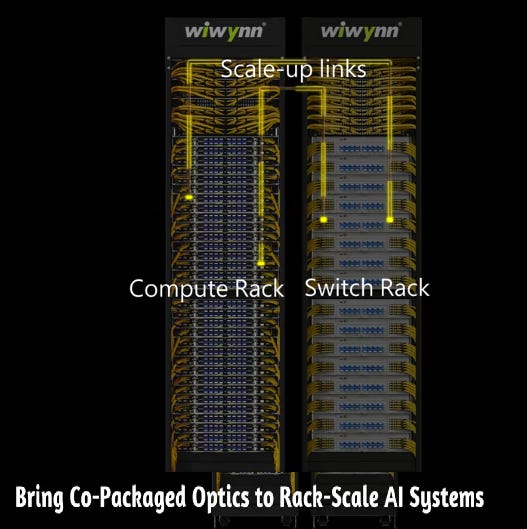
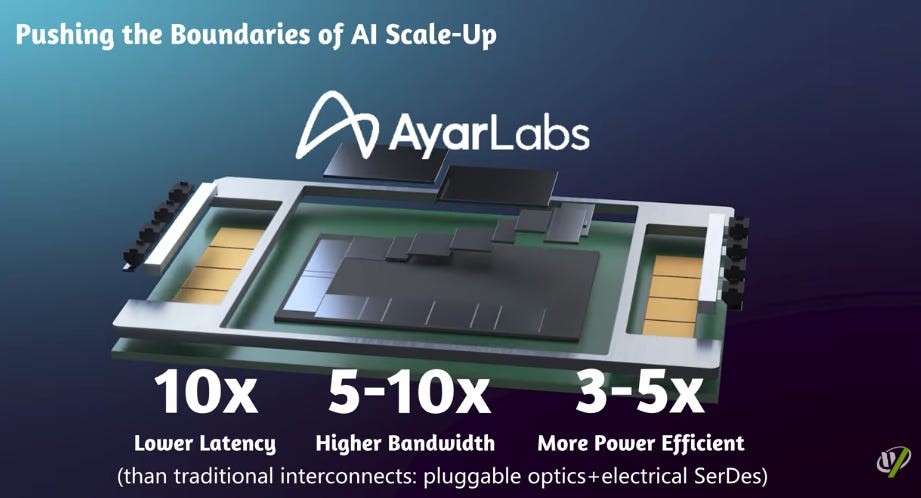
This is not simply a photonic switch demonstration. This is a rack-scale optical fabric supporting full optical I/O next to the XPU/ASIC. This may ultimately prove to be the most important architectural shift in AI networking. Ayar Labs claim staggering improvements:
Why This Matters
Goldman’s report is primarily modeling a switch-centric world. The architecture generally looks like:
Switch ASIC
↓
Optical Engine
↓
External Laser Source
This is a networking-centric deployment model.
The Ayar/Wiwynn demonstration move optics much closer to compute.
The architecture instead becomes:
AI ASIC
↓
Optical Engine
↓
Remote Light Source
↓
Optical Fabric
This is a compute-centric deployment model. That distinction may sound subtle. It isn’t, this is the end game of the AI Photonics.
The Scale-Up Opportunity
One of the most important conclusions in the Goldman report is that scale-up networking becomes larger than scale-out networking. Goldman estimates that scale-up networking could represent approximately $106 billion of the total $154 billion TAM. This is a critical shift. Historically, investors thought about optical networking primarily as connections between racks (scale out). Increasingly, the largest opportunity appears to be inside the AI cluster itself.
Between accelerators.
Between racks.
Across large unified AI systems.
That is precisely the problem optical I/O is attempting to solve and the end-game for AI Photonics.
The Most Interesting Unanswered Question
The Goldman report successfully models:
Pluggables
Switch-CPO
Optical engines
External laser sources
Rack-level content
What Goldman does not yet model is the eventual transition to optical I/O at scale.
Questions remain:
When will hyperscalers deploy optical I/O?
How quickly can reliability be proven?
How will system architectures evolve?
How much optical content will be required at the compute layer?
The guess has been 2028-2030 with ramp start in 2027.
We have a model and a TAM for Goldman’s switch-CPO assumptions. For CPO they suggest approximately: 30–60 External light sources per rack. Which contributes to Goldman Sachs' projected $154 billion optical networking TAM.
However with Wiwynn and Ayar Labs Computex 2026 announcement we get the first glims of the total number of External light sources per rack in a CPO XPU/XPU architecture, which shows 512 units per rack.
Conclusion
The headline takeaway from Goldman’s report was a potential $154 billion optical networking market. After Computex 2026 takeaway may be something else. Goldman’s roadmap acknowledges a future where optics move beyond switches and become part of the compute fabric itself.
At Computex 2026, Wiwynn and Ayar Labs may have provided one of the clearest public demonstrations yet of what that future could look like.
The question is no longer:
Will optical networking become critical to AI infrastructure?
Goldman has already answered that.
The question now is:
How quickly will the industry move from only switch-centric CPO to also start using optical I/O?
This transition may ultimately define the next phase of AI networking, since the Wiwynn and Ayar Labs Computex 2026 announcement offers a first understanding of the total number of External light sources per rack in a CPO XPU/XPU architecture. If the SuperNova assembly count can be compared directly with Goldman’s ELS assumptions, the resulting light-source density would be materially higher (8-15x) than the switch-centric CPO architectures modeled today. Further work is needed to determine whether these metrics are directly comparable. This would be replacing old copper NVLink type solutions and hence will be a 100% add-on to the current TAM.
Interestingly, this possibility aligns with NVIDIA's recent expansion of the NVLink Fusion ecosystem, which now includes optical-interconnect specialists such as Ayar Labs, LightMatter. While NVIDIA has not publicly disclosed its long-term Optical I/O roadmap, the ecosystem being assembled today appears increasingly consistent with the type of "CPO with XPU" architecture Goldman identified but could not yet model.
Goldman explicitly models the transition from pluggables to switch-centric CPO. Computex 2026 may have shown the industry's first glimpse of what comes next: Optical I/O at the compute layer. The question is no longer whether optics will become critical to AI infrastructure. The question is how quickly optics move from the switch to the accelerator itself.
Anders Storm
Disclosure: This analysis is for informational purposes only and does not constitute investment advice.
The author has positions in stocks that might be related to companies in this article Sivers, GlobalFoundries. Readers are highly recommended to conduct their own due diligence on any investment.
Great piece, TYVM for insightful analysis.
Thanks for sharing the insights! Good articles like this stimulate a lot of thoughts and resonate with the readers. Before, the market predictions were based on "how to build highways." A new question emerges: "Should we let everyone drive a Ferrari?" I can only imagine that the capex will be unbounded. The extent depends on how much the computing and transmission are bottlenecked on rack-level and how much hyperscalers are willing to invest.