What We Learned From Computex Part 2: The AI Compute Is Becoming one Large AI Compute Cluster
Ayar Labs and Wiwynn are building the optical scale-up architecture for 1,000+ accelerator AI systems. Making external light source infrastructure, not a component.

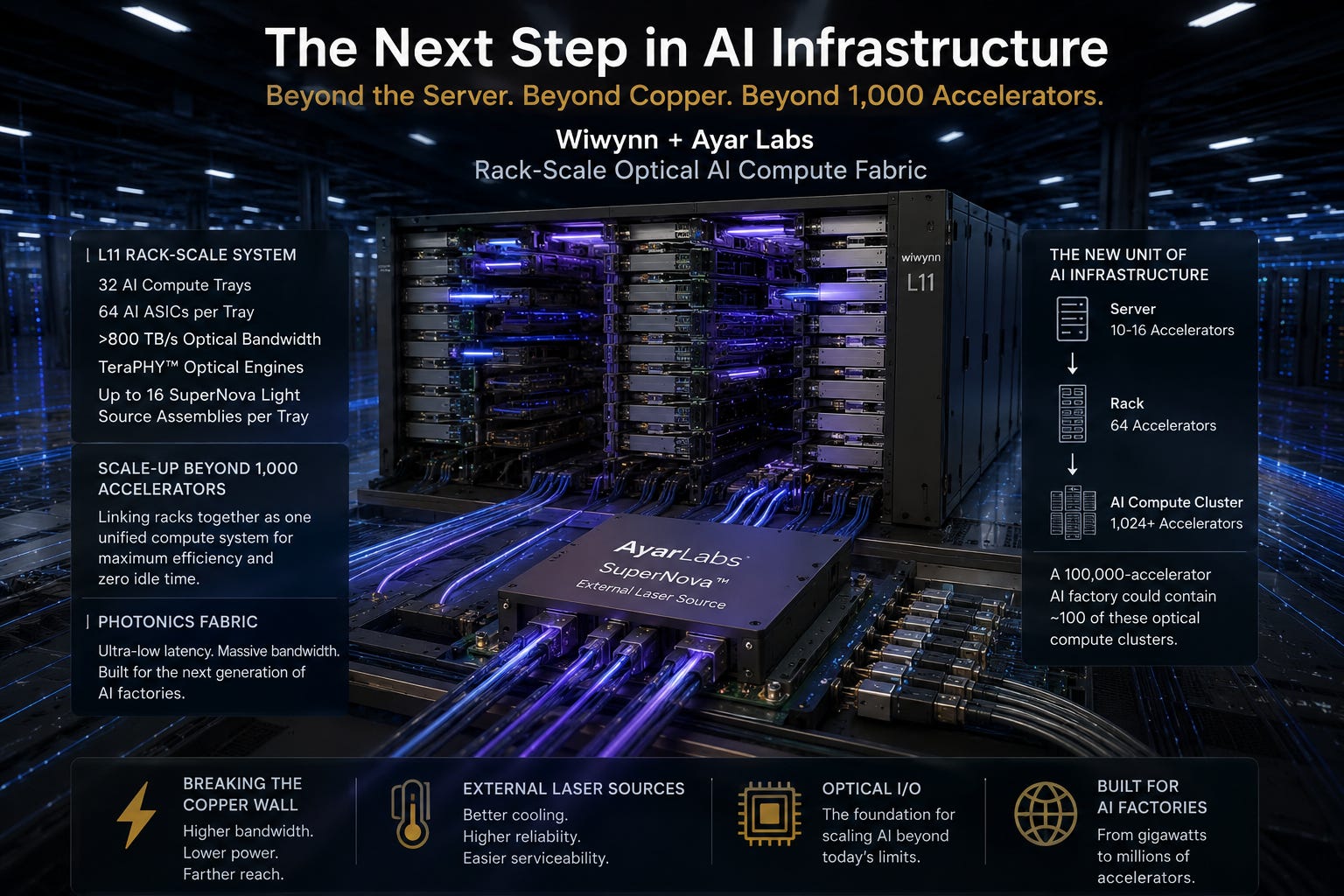
For decades, the definition of a computer was simple A processor - Memory - Storage - Networking. All inside one box.
The data center was simply a warehouse filled with thousands of those boxes. But artificial intelligence is changing that. The bottleneck is no longer only the chip. The bottleneck is interconnect and the need for a optical fabric.
The next step in Scale-up is to link racks together and unlock shared compute efficiencies to avoid GPU/CPU/XPU idle time among other benefits. These AI compute clusters will soon be scaling beyond 1,000+ accelerators.
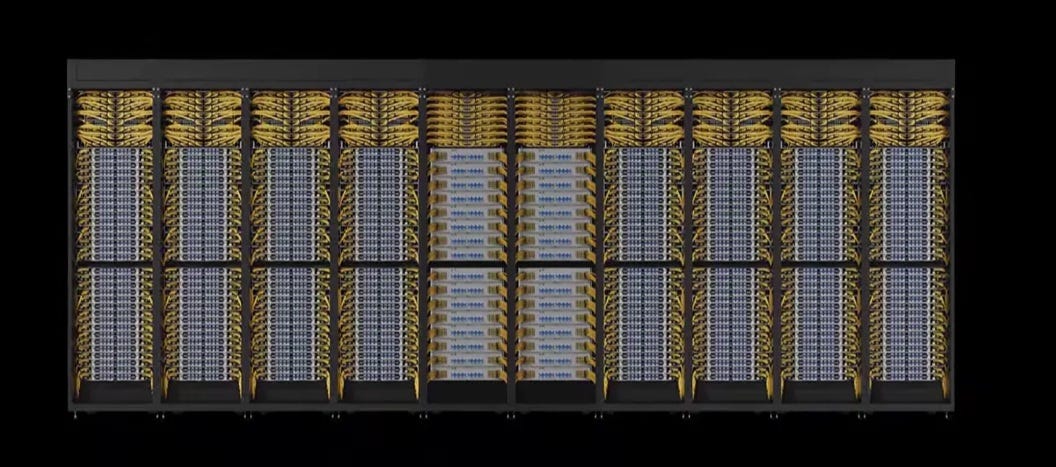
Above picture: Wiwynn rack-scale multiple rack scale-up fabric 8 compute and 2 switch nodes
To fully utilize these accelerator clusters, high bandwidth and low latency are needed. That is why next‑generation AI systems are increasingly shifting to co-packaged optics (CPO) or Optical IO. Traditional copper interconnects increasingly constrain performance, system growth, and power efficiency. At the speed these interconnects operate, copper can only reach a few meters without signal degradation. Conventional pluggable optics, found in data centers today, are too inefficient to be viable as scale-up fabrics push toward 1,000+ accelerators and ever-higher bandwidth density
The Copper Wall
Currently AI compute had been improved by adding more accelerators, racks, and networking (Scale-out). But processors became faster than the infrastructure connecting them.
Compute ↓ Memory ↓ Interconnect
Copper built modern computing, but at extreme AI bandwidth, copper becomes increasingly difficult to scale efficiently.
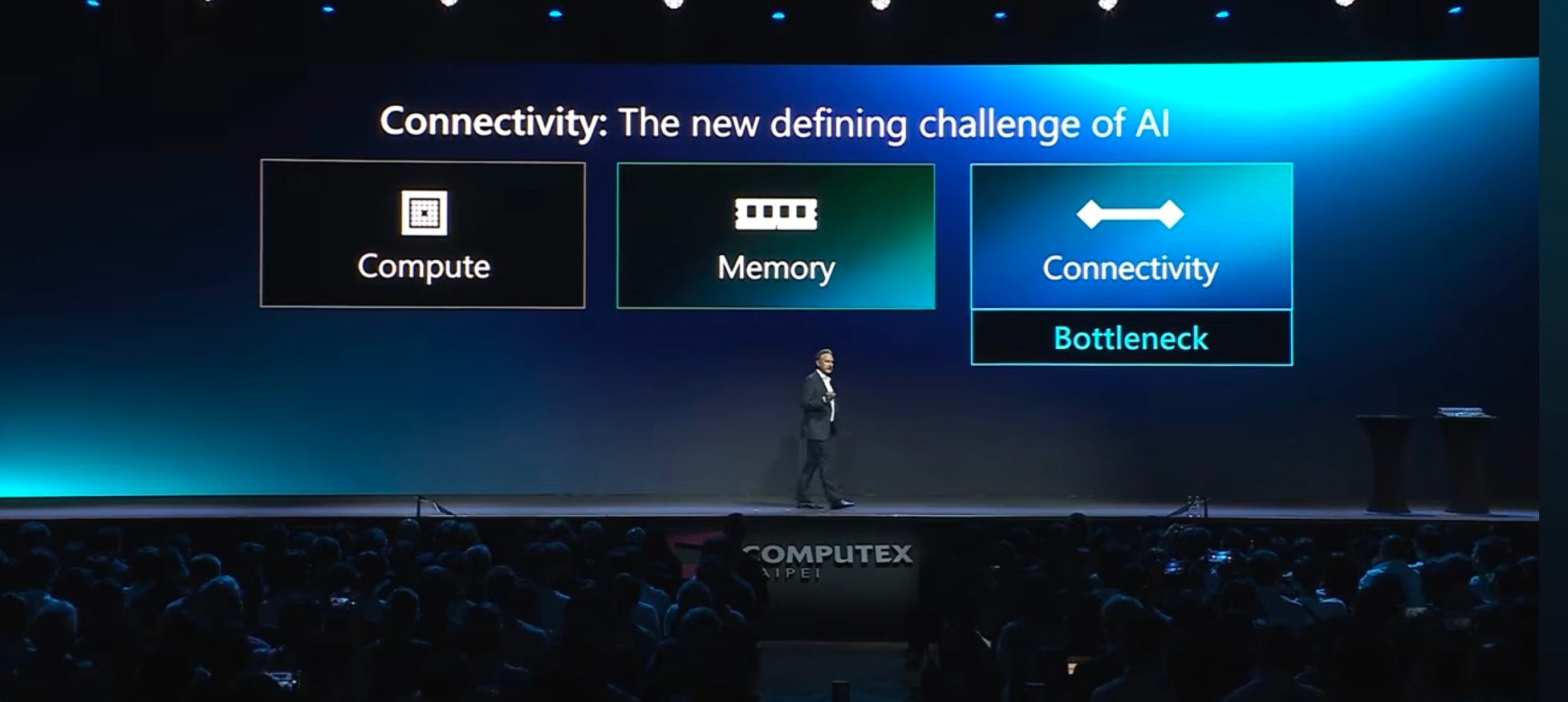
Marvell CEO at Computex 2026
Distance: AI wants thousands of accelerators acting together.
Density: More bandwidth means more cables and complexity.
Heat: Moving data creates thermal problems.
Everyone Expected a “Slow” Optical Transition
Copper → Linear optics → Near-package optics → Co-packaged optics → Optical I/O
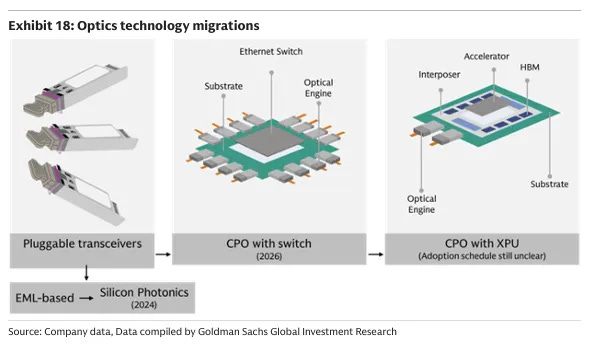
If you remember the right hand box that Goldman have not yet calculated in the Optical Networking report from April 2026.
But what if optics IO is already available sooner? Was this what Wiwynn and Ayar shared at Computex 2026? Could hyperscalers move faster than expected by designing new AI campuses around optical fabrics from the beginning? I.e. for completely new data centers, can they us the L11 rack that has now been presented?
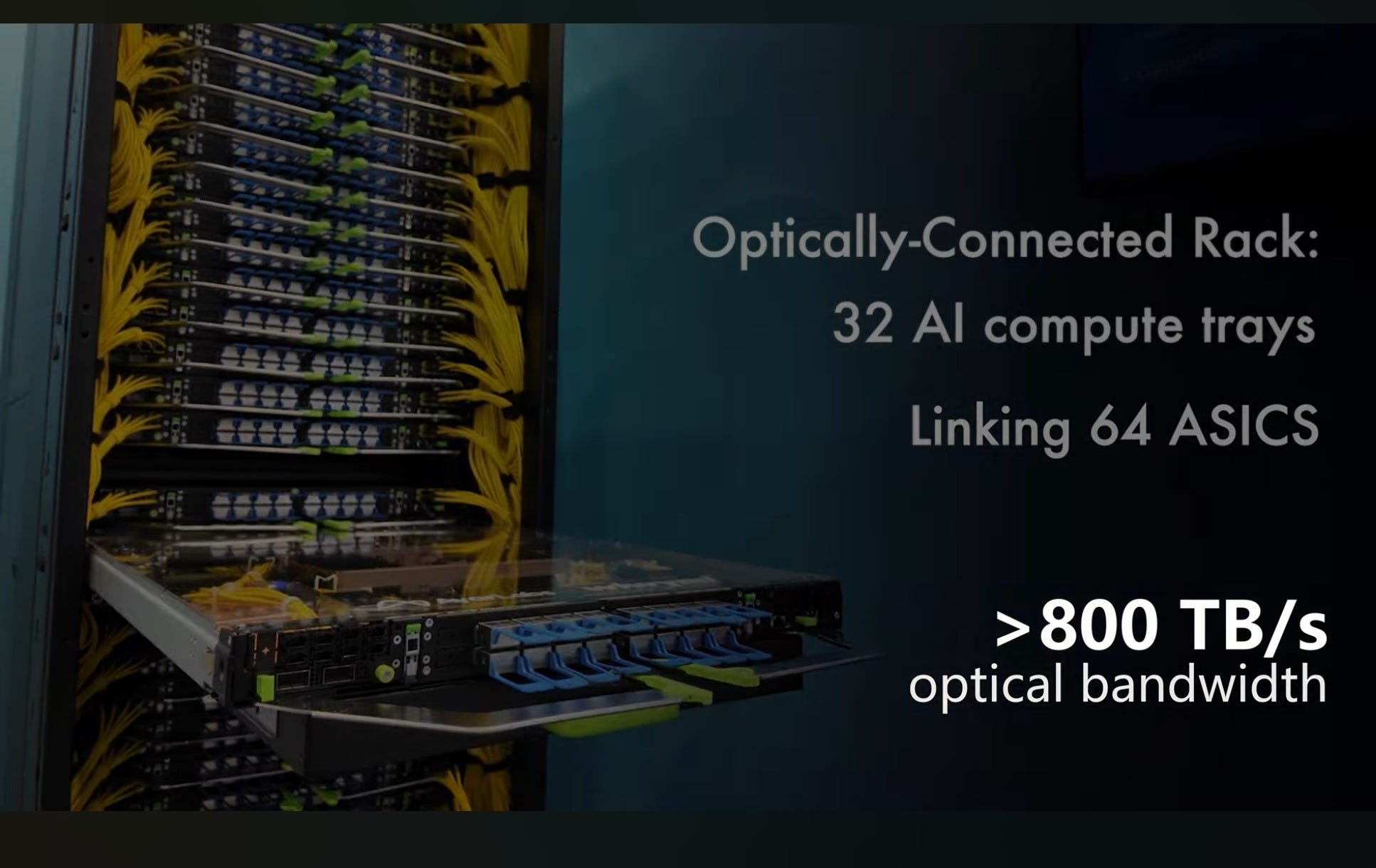
Wiwynn + Ayar Labs: Scale-up scaling beyond 1,000 accelerators
They are not building a faster cable. They are building a new AI compute optical fabric.
Old world: Server = computer. Rack = collection of computers.
Wiwynn AI compute: Large Rack clusters one large compute node. At Computex they show the future here and now.
A photonics startup demonstrating a chip is one thing. A hyperscaler manufacturer like Wiwynn demonstrating a full L11 rack system is something completely different. Wiwynn solves manufacturing, cooling, serviceability, and deployment. They don't develop this on their own initiative, they are not a rack product company, they are a contract manufacturer. That opens up for three questions:
Which Hyperscaler is behind this?
When will they start deployments?
How many External Laser Small form Factor Pluggable (ELSFP) can we expect in such a scenario?
The Optical Tray and Rack
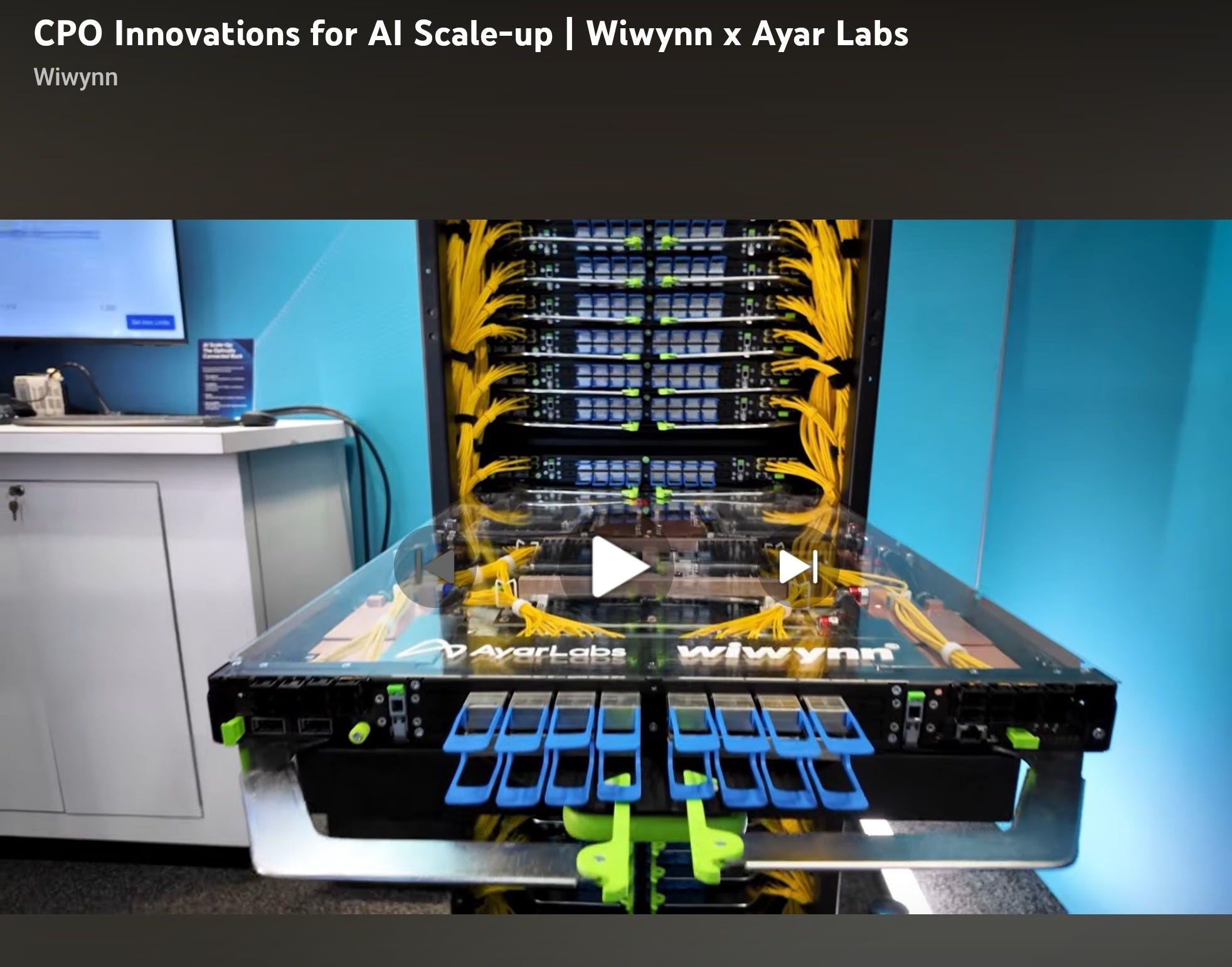
The full rack solution featured:
32 AI compute trays
64 AI ASICs
More than 800 TB/s optical bandwidth
TeraPHY optical engines
Publicly presented system diagrams indicate up to 16 SuperNova light source assemblies per compute tray. Applied across 32 trays (L11 configuration), this implies a theoretical maximum of 512 SuperNova assemblies within the compute rack architecture.
Rack-scale optical connectivity designed for hyperscale AI infrastructure.
The full compute cluster and the ELS economics per AI compute datacenter
Let’s assume an AI scale-up cluster supporting 1,024 accelerators. 64 ASICs per rack = 16 Racks in one cluster.
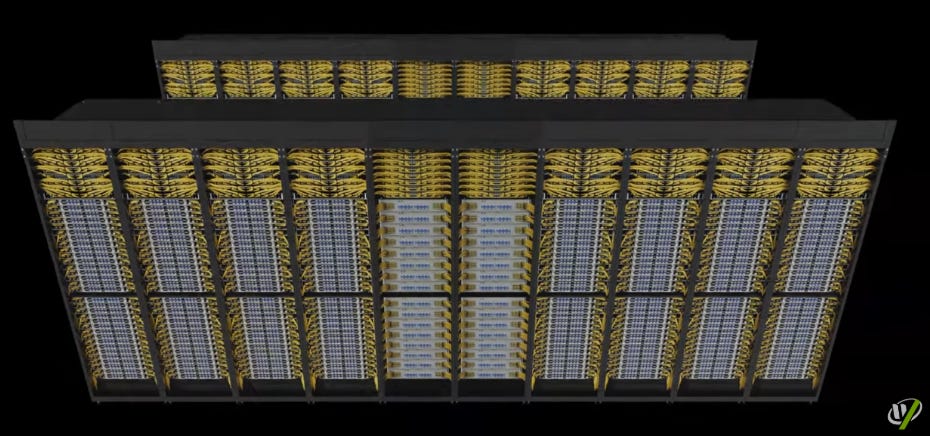
16 Racks × 512 ELSFP => 8192 ELSFP
This gives high‑bandwidth, ultra‑low‑latency optical links between AI accelerators across systems and racks. This lets accelerators in different racks communicate, enabling accelerators across racks to operate as one tightly coupled AI cluster, enabling efficient scale‑up for thousands of GPUs.
The unit of AI infrastructure shifts from “server” to “1,024-accelerator optical computer.” A 100,000-accelerator AI factory could contain roughly 100 of these compute clusters. Which is approximately 820.000 ELSFP.
Connecting this to a single hyperscaler AI campus: Power: 1 GW. Accelerators: 200,000–500,000+. Optical clusters: 200–500 Ayar/Wiwynn-style domains. This would be approximately 2-5x in size.
The Breakthrough — External Laser Sources
Keep reading with a 7-day free trial
Subscribe to Anders Storm to keep reading this post and get 7 days of free access to the full post archives.